
Management
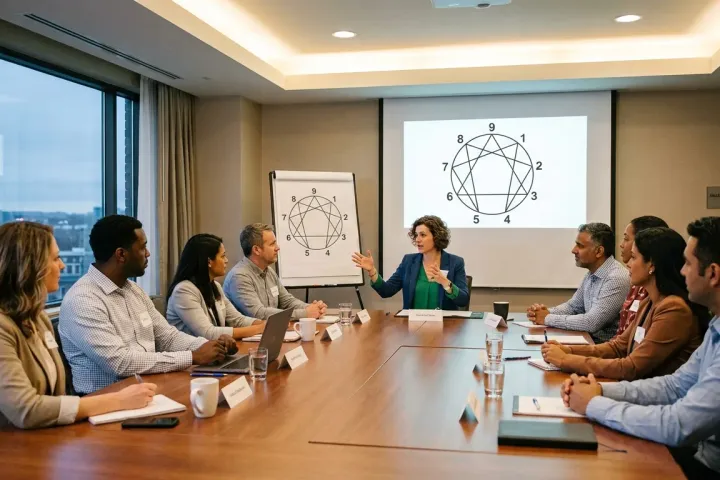
Managing with the Enneagram
The same feedback produces a useful rethink in one person and a month of withdrawal in another. One day to recognise your profile, read your team's, and stop managing everyone as if they wanted what you want.
What you will be able to do
- Know the 9 bases of the Enneagram
- Know your own personality base in the Enneagram
- Know the base of each of your direct reports
- Give feedback adapted to each personality base
- Adapt your delegation to each base
- Motivate each person according to their personality
Programme
A reminder of each participant's Enneagram base
- The vocabulary of the Enneagram
- The main characteristics, strengths and areas for improvement of each base
Which profiles make up my team?
- Identifying the profiles around me, and which ones dominate
- Drawing on other tools and methods, depending on the trainer's certification
- Involving the team member in determining their own profile
Managing each base
- Communicating and giving feedback with each profile
- Coaching, motivating, setting the frame and correcting with each profile
- The strengths to build on
- Each base's relationship to authority
Keeping the Enneagram alive in the team
- Ideas and tips for making it last
What is the Enneagram?
A method for studying personality based on nine patterns of behaviour. It is a tool for knowing yourself better and, in a management context, for understanding what drives the people you lead.
One day: your profile, the nine readings, and what each one expects from a manager.
Temperament, not canton
Teams in French-speaking Switzerland regularly work with colleagues from German-speaking Switzerland, and with people recruited from outside the country. The shortcut of reading a way of working as a regional trait is convenient and usually wrong.
The Enneagram is used here to come back to the person: nine motivations, nine reactions under pressure, and a way of checking your hypothesis by talking to the person concerned rather than applying it to them.
Questions about this training
Do I need to have followed a management training first?
It is strongly recommended. The day works on tailoring a foundation it assumes is in place: a clear framework, feedback, delegation, one-to-ones. Without it, the day offers a way of reading people without the management practice to apply it to.
Is the Enneagram scientifically validated?
No, and it is not presented otherwise. It is a model for understanding, not a measuring instrument. Its interest is practical: nine hypotheses about motivation that a manager can check in conversation with the person, rather than apply to them.
What does it change day to day?
Three specific things: how you brief, how you phrase feedback, and the form recognition takes. The same message does not have the same effect depending on what drives the person, and one day is enough to stop using a single register with the whole team.
Is it useful in a team spanning French- and German-speaking Switzerland?
Yes, and it is a frequent use. The model separates temperament from culture, which avoids attributing to a regional difference what belongs to the person. That confusion is costly in teams working on both sides of the language border.
Related trainings

The manager-leader toolkit
The firm's core programme. Three days to stop settling everything case by case and to have tools that hold: set a frame, correct without humiliating, delegate for real, and adapt how you work to each person.

Non-financial motivation levers and team coaching
In a country where salaries are already high, a pay rise is no longer what keeps someone. Two days to organise motivation differently: twelve practical levers, mediating a conflict, and a team vision that people take on as their own.

Hybrid and remote management
Managing at a distance is not doing the same thing through a screen, especially when part of the team crosses a border every morning. One day to set clear rules from the start, write objectives that can be read without you, and keep rituals that do not wear away.